

Wellington Boot Size and Fit Guide
Choosing the right size and fit without trying wellies on can be difficult. This guide explains which size to start with, how to measure, how wellies should feel around the foot and calf, and how to check the fit before wearing them outdoors.
Most customers find that their usual shoe size is the correct size in a wellington boot. However, the right fit can also depend on the brand, boot height, calf width and what you plan to wear inside your wellies.
If your first choice is not quite right, simply follow our no-quibble returns procedure and we will be happy to exchange your boots.
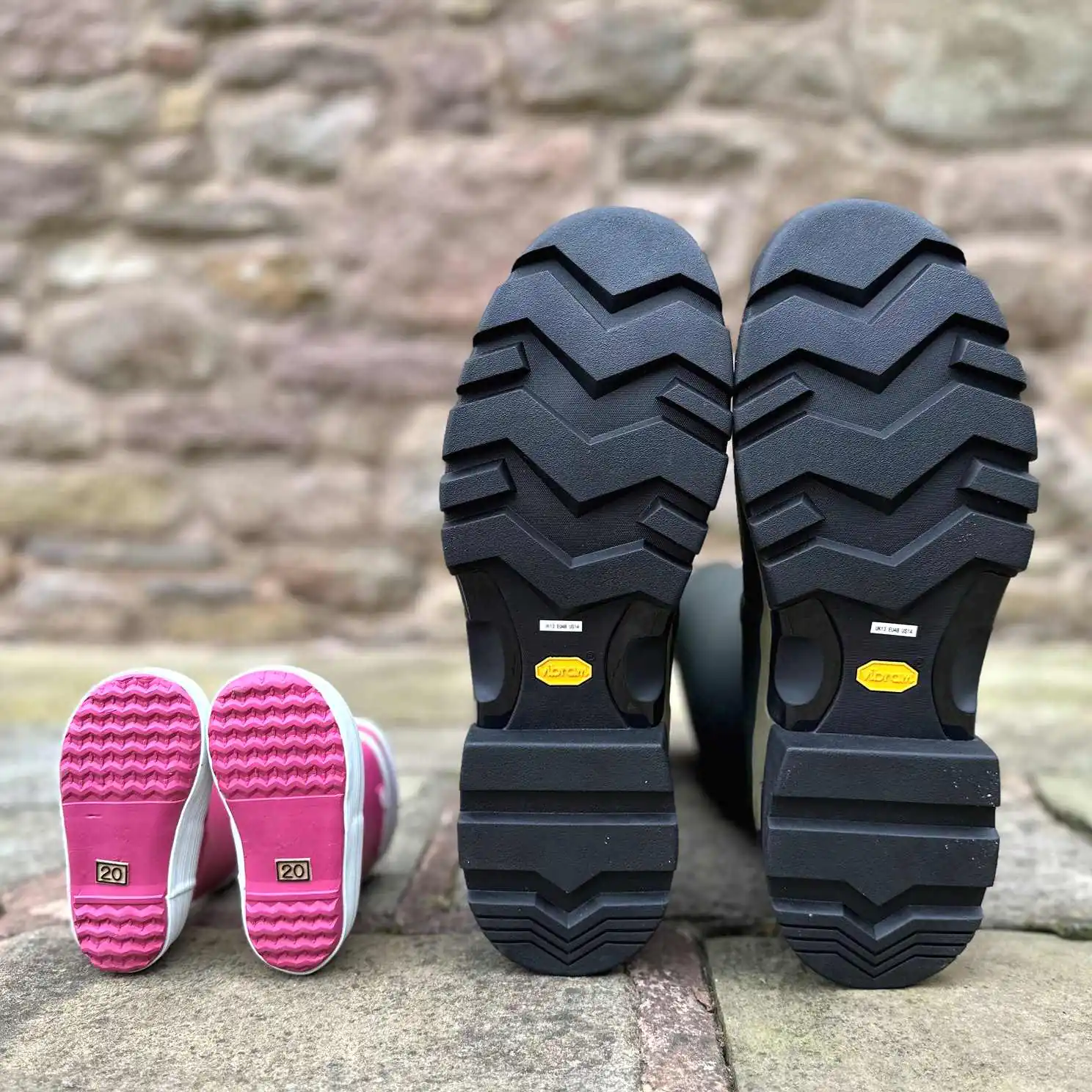
How should wellies fit?
Wellies should feel comfortably secure without pinching your feet or calves. Your toes should not touch the end of the boot, and there should be enough room for the socks you normally wear. A small amount of heel movement can be normal, but your foot should not slide excessively as you walk.
- Your toes can move without feeling cramped.
- The sides do not press against the widest part of your foot.
- Your heel remains reasonably secure while walking.
- The upper does not dig into your calf or the back of your knee.
- There is enough room for your usual socks and trousers.
- You can walk and bend your knees comfortably.
The ideal fit
Which Foot Size Should I Choose?
As a general guideline, the size you normally wear in an everyday shoe or boot will usually be the correct size in a wellington boot too.
Start with your usual UK shoe size unless the individual product page advises you to choose differently.
This will not be right for absolutely everyone, and we cannot guarantee that every brand will fit in exactly the same way. Some wellingtons come up slightly larger, smaller, wider or narrower than expected.
At Welly Warehouse we sell thousands of pairs of wellington boots every year, and we always welcome customer feedback. Where we know a particular style fits differently, we include that information in the product description. Always check the individual product page (especially the size chart, if there is one) for brand-specific sizing advice before ordering.
Think about what you will wear inside your wellies
Most of the brands we sell provide enough room in your usual shoe size for a thick pair of socks. However, you should also consider the trousers and other clothing you will wear inside the boots.
- Thick walking or thermal socks
- Jeans or trousers tucked into the boot
- Thermal leggings or waterproof trousers
- Extra insoles or footbeds
- Long periods of walking or standing
- Your preference for a snug or roomy fit
What if I am between sizes?
If you normally wear a half size and the wellington is only available in whole sizes, think about how you intend to use it.
Choosing the larger size may be more comfortable for winter use, thick socks or additional insoles. For lighter use with normal socks, the nearest whole size may be suitable.
Always check the product description and any size chart first, as the best choice can vary between brands and styles.
How much room should there be around your toes?
Your toes should be able to lie naturally without touching the end or sides of the boot. You should also be able to move them slightly while wearing the socks you intend to use with your wellies.
The boot should not press against the widest part of your foot. Pinching, numbness or obvious pressure across the toes normally means that the boot is too small or too narrow.
Your feet feel restricted
- Your toes touch the front of the boot.
- The sides press against your foot.
- Your toes feel cramped or numb.
- Thicker socks make the boots uncomfortable.
Your feet move excessively
- Your foot slides from side to side.
- Your toes repeatedly move into the front.
- The boots feel difficult to control.
- Your socks rub or begin to work down.
Should your heel lift in wellies?
As wellies do not fasten closely around the foot in the same way as lace up boots do, a roomier fit is generally to be expected. However, heel lift or movement should be minimal, and the boot should still hold to your foot as you walk to avoid the risk of rubbing.
If your heel rises significantly with every step, the boot feels tiring to control or your socks begin to rub or slip down, the size or boot shape may be too generous.
A suitable walking sock or supportive insole may improve a slightly roomy fit, but it should not be used to compensate for a boot that is clearly too large.
How should wellies fit around the calf?
The top of the boot should sit comfortably around your calf without digging in. Allow enough room for the trousers and socks you expect to wear inside the boots, as well as enough space to walk, bend your knees and sit comfortably.
A closer fit can help reduce movement, but the upper should not feel restrictive. If it presses into your calf while standing still, it is likely to become more uncomfortable when walking.
If you regularly find tall boots too tight around the calf, you might consider a shorter boot, a style with an adjustable gusset, or flexible uppers such as waterproof neoprene which offers an amount of stretch.
How to Measure Your Calf for Wellington Boots
Calf size is one of the most important measurements when choosing a tall wellington boot. A boot may fit your foot correctly but still feel too tight around your leg.
For the most accurate result, take your measurement while wearing the clothing you would normally wear inside your wellies.
- Put on your usual trousers or jeans and the socks you expect to wear with your boots.
- Sit on a chair with both feet flat on the floor and your lower legs in a natural upright position.
- Find the widest part of your calf.
- Wrap a flexible tape measure around this point.
- Keep the tape comfortably close to your leg without pulling it tight.
- Allow enough room to slide one or two fingers between the tape and your leg.
- Record the measurement and compare it with the calf size shown on the product page.
Wrap a piece of string around the widest part of your calf, mark where the ends meet and then measure the string against a ruler.
Measure both legs
It is normal for one calf to be slightly larger than the other. Measure both legs and use the larger measurement when choosing your boots.
Leave room for comfort and movement
Your calf measurement should not be exactly the same as the maximum internal circumference of the boot. You need a little extra room for clothing, movement and comfortable removal.
If your measurement is very close to the stated maximum calf size, an adjustable or wide-calf style will usually be the safer choice.
Choosing the Right Calf Fit
Once you have measured the widest part of your calf, compare the result with the calf measurements shown on the individual product page. Measurements can vary between brands and styles, so it is important to check each boot rather than relying only on labels such as slim, standard or wide fit.
A wellington boot should feel secure around the lower leg without pinching or pressing into your calf. You should be able to walk, bend your knee and tuck in your usual trousers comfortably. A little space is normal, but a very large gap can allow water, mud or debris into the boot and may create excess movement.
Your calf measurement should normally be smaller than the maximum internal circumference of the boot. Allow some additional room for clothing, movement and putting the boots on and taking them off.
If your measurement is very close to the maximum stated calf size, an adjustable or wider-fitting style will usually be the more comfortable choice. This is particularly important if you plan to wear waterproof trousers, winter layers or thicker clothing inside the boots.
Slim-Fit Wellies
Slim-fit wellingtons sit closer to the lower leg and may suit customers with narrower calves or those who prefer a more fitted shape.
Standard-Fit Wellies
Standard-fit styles are designed to suit a broad range of calf sizes and are a practical starting point for everyday use.
Wide-Calf Wellies
Wide-calf wellies provide extra space around the lower leg. They may also be useful when wearing thicker trousers, waterproof clothing or winter layers.
Adjustable-Calf Wellies
Adjustable styles use gussets, buckles, straps or expandable panels to help you create a more personalised fit around the calf.
What if your measurement falls between two sizes?
The slightly roomier option is usually the safer choice, especially if you intend to wear thicker socks, waterproof trousers or winter clothing. However, avoid choosing a boot with substantially more space than you need, as this may feel loose while walking.
Rubber, synthetic rubber and PVC may become more flexible with use, but they do not stretch in the same way as soft leather or fabric. Do not rely on a tight boot becoming significantly wider around the calf.
Choosing the Right Boot Height
Boot height can affect calf fit as well as the amount of protection a wellington provides.
Tall Wellies
Full-height wellingtons offer the most protection from water and mud. Because they reach higher up the leg, they are also more likely to sit around the widest part of the calf.
Mid-Height Wellies
Mid-height boots provide useful protection while sitting lower on the leg. They may feel less restrictive than a full-height boot.
Short Wellies
Ankle and short wellingtons avoid the widest part of the calf and are often easier to put on and remove.
Tall wellies provide more coverage, but the top should not press into the back of your knee. If it does, a mid-height or shorter style may give you a more comfortable fit.
How to check the fit of new wellies
Try new wellies indoors on a clean, dry surface while wearing the socks and clothing you would normally use with them.
- Stand naturally. Check that your toes and the sides of your feet do not feel compressed.
- Walk around for several minutes. Pay attention to heel lift, sideways movement and any rubbing.
- Bend your knees and sit down. Make sure the upper does not dig into your calf or the back of your knee.
- Carefully try a step or staircase. Check whether your toes slide into the front of the boot.
- Remove the boots and check your feet. Red marks or clear pressure points may indicate that the boots are too tight or the wrong shape.
A good fit should feel comfortable from the start
Rubber and neoprene may become softer and more flexible with use, but you should not rely on wellies stretching significantly to correct a tight or uncomfortable fit.
Adult Wellington Boot Size Conversions
Welly Warehouse stocks brands from around the world. Use the table below as a general guide when converting European sizes to UK adult sizes.
These conversions are generic. Some manufacturers use slightly different conversions, so please refer to the sizing information on the individual product page where available.
| Euro | 36 | 37 | 38 | 39 | 40 | 41 | 42 | 43 | 44 | 45 | 46 | 47 | 48 | 49 | 50 | 51 |
|---|---|---|---|---|---|---|---|---|---|---|---|---|---|---|---|---|
| UK | 3 | 4 | 5 | 6 | 6.5 | 7 | 8 | 9 | 10 | 10.5 | 11 | 12 | 13 | 14 | 14.5 | 15 |
Children's Wellington Boot Size Conversions
Use this table as a general guide when converting European children's sizes to UK sizes.
Children's feet grow quickly, but buying boots that are much too large can cause the foot to move around and may make walking uncomfortable. Allow sensible growing room while ensuring the heel remains reasonably secure.
| Euro | 19 | 20 | 21 | 22 | 23 | 24 | 25 | 26 | 27 | 28 | 29 | 30 | 31 | 32 | 33 | 34 | 35 |
|---|---|---|---|---|---|---|---|---|---|---|---|---|---|---|---|---|---|
| UK | 3 | 4 | 4.5 | 5 | 6 | 7 | 7.5 | 8.5 | 9 | 10 | 11 | 11.5 | 12.5 | 13 | 1 | 2 | 2.5 |
Checking the fit of children's wellies
- The heel should not lift excessively while walking
- The toes should have some comfortable movement
- The top of the boot should not rub the leg
- The child should be able to walk naturally
Wellington Boot Sizing FAQs
Should I buy a size bigger in wellington boots?
Usually not. Most customers find that their normal shoe size is the best place to start, and many wellington boots already allow enough space for thicker socks.
You may prefer to size up if you are between sizes, intend to use thick insoles or plan to wear very heavy winter socks. Check the individual product description before deciding.
Should wellies feel loose?
Wellington boots are not normally as close-fitting as ordinary shoes. A small amount of movement is expected, but your foot should not slide around excessively.
If the heel lifts significantly or your foot moves from side to side, the boot may be too large or too wide.
Can I wear thick socks in my normal welly size?
In most of the brands we sell, your usual shoe size should provide enough room for a thick sock. However, this can vary between styles, so check the product-specific sizing notes.
Do rubber wellies stretch around the calf?
Rubber may flex slightly while you move, but it should not be expected to stretch enough to change the fit of a boot that is already too tight.
Choose a boot with the correct calf measurement rather than relying on the material to loosen over time.
What should I do if I have wide calves?
Measure the widest part of both calves while wearing your normal clothing. Use the larger measurement and compare it with the dimensions on the product page.
Look for wide-calf, adjustable-calf or shorter styles if a standard tall boot is likely to feel restrictive.
Why does my usual size fit differently between brands?
Brands use different lasts, moulds, linings and size conversions. Two boots carrying the same size may therefore differ in internal length, width, calf circumference and overall shape.
Always read the product description for any sizing advice specific to that brand or style.
What if the foot fits but the calf is too tight?
Changing the foot size is not always the best solution, as a larger size may become too loose around your foot.
Instead, look for another style with a wider or adjustable calf, or consider a shorter boot that finishes below the widest part of your leg.
How do I know whether a welly is too small?
The boot may be too small if your toes touch the end, the sides squeeze your foot, the top presses into your calf or the boot is difficult to remove even with a boot jack.
Ready to find your perfect pair?
You now know how wellies should fit, how to measure your calf and how to compare sizing between styles. Explore our collections to find the right boots for your activities and preferred fit.